Wednesday

Purpose of the Guest Gallery

This gallery has been opened to display images of quality portrait miniatures submitted by private owners of limited numbers of miniatures who wish to share their images and help enhance the exhibition as a reference collection of privately owned miniatures.

It therefore represents an opportunity for private owners to display miniatures that would otherwise never be seen by the public and also to invite answers to any research questions they may have about the miniatures.

Several owners have now submitted portraits. Most recently, a Dutch collector has submitted some fine European items. A New Zealand collector is showing is a family group from London, England which is still being researched. From a collector in Chile is a very interesting group associated with the artist Antonio Meucci. An American owner has sent a portrait believed to be by Raphaelle Peale.

Additionally, owners of more substantial numbers of miniatures can have a free exhibition in a dedicated Gallery, such as Une Collection Francaise which shows a selection from a French collector's collection of 18C and early 19C French miniatures.

Other items for display are welcome and the owner's name and contact address will not be displayed unless it is requested. There is no charge associated with submission of a miniature portrait. An email containing images and any known details about the portrait is all that is necessary. Click on About Me for my email address to send them to.

For more about the Artists and Ancestors Collection or about recent additions to the main collection click on Home or 2008 Additions and Comment

Sunday

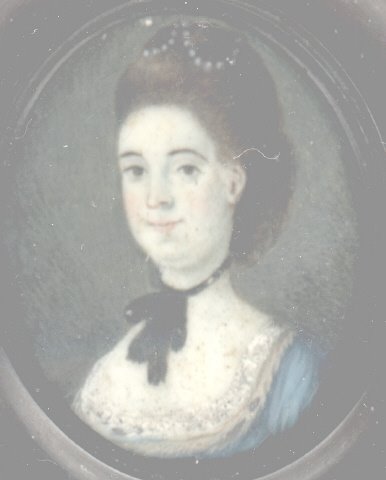
Brown, John Henry - portrait of Mary Morgan Destouet

A visitor to the website has sent me a photocopy of this miniature, together with a little information about the sitter and is keen to know more, if any other visitor has any relevant comments to add.

The miniature is of Mary Destouet nee Maria Morgan, and was painted by John Henry Brown in 1860.

I have checked the list of twenty portraits he painted in 1860 and this one was painted immediately after he painted his miniature portrait of Abraham Lincoln. Brown describes it as being based on a daguerreotype. This usually implies the sitter had already died when the miniature was painted, although that cannot have been the case here as Mary Destouet was still alive for the 1870 census.

Mary only looks to be about 45 in the miniature and perhaps 1845-1850 was the date of the daguerreotype, with Mary feeling she did not want the miniature to record her looks at age 57, as she was in 1860.

It is interesting to compare it with another miniature painted several months earlier in 1860 by Brown and which is in this collection, see View That is of Maria Charlotte Gouverneur Cadwalader and her dress is almost identical, varying only in the fine details of the lace. I think Brown must have used the Cadwalader miniature as a model for the Destouet dress, as even the way the bottom of the lace caps are draped on the two sitter's shoulders is identical.

This perhaps seems unusual, but it may be the clothing fashion worn in the Destouet daguerreotype was several years out of date and hence Brown posed Mary Destouet in the fashion of 1860, as worn by Maria Cadwalader.

There is not a lot of information about the Destouet family available on the Internet, but immigration records show that Saturnius Destouet (sometimes Destouit) arrived in the USA in 1817 and was naturalised on 6 Jun 1817. According to a note which the miniature owner acquired with the portrait, Destouet was a Marquis by rank and possibly fled from France a couple of years after Napoleon's defeat.

The marriage of Saturninus Destouet (also Saturnius Destouet) and Mary Morgan is recorded in Philadelphia on 3 Jun 1820. On 19 Sep 1828 they returned to New York from Le Harvre, France with Mary giving her age as 26, together with William H Destouit aged 31 (1897-?), on the ship "Charlemagne". In the 1825 Directory S & B Destouet are recorded as merchants at 209 High d. h. Chestnut, one door below the Academy of Fine Arts. Destouet Bros are recorded as importers and dealers in silk goods. Saturnius Destouet is listed in the 1830 census as living in the South Ward of Philadelphia.

In the 1860 census for the 8th Ward of Philadelphis, they are wrongly recorded under the name Destoalet, but are Sartain Destouet and Mary M Destouet. Confirmation of this, is that John E Destouet aged 63, possibly a brother of Sartain, is resident in the same house.

At the census, Sartain aged 67 (1893-?) and Mary 56 (1803-?) have five daughters; Eloise 30 (1830-?), Delia 25 (1835-?), Mary 23 (1837-?), Julia 21 (1839), and Eliza C 18 (1842-?). Sartain gives his occupation as Gentleman, his assets as $50,000 and his place of birth as France. Also in the household are a coachman and four other servants, all from Ireland and so undoubtedly emigrants escaping from from the Irish potato famine of 1845-1850.

By the time of the 1870 census on Nov 15, Mary Destouet aged 70 is living in Walnut Street Philadelphia, with only two daughters; Ellie 28 and Caroline aged 32. However, they still have five servants.

Although referred to as Delia in the census, it appears that the proper name of the second daughter was Zelie Zanade Destouet and she married Thomas Treves-Barber. Their son Thomas Henry de Treves Destouet Barber married Winifred Riddly, both of whom died in Johannesburg, SA but Thomas Destouet Barber was a doctor and the author of "Treatment of Varicose Veins of the Lower Extremities by Injection."

There seems to have been some connection between Delia or Zelie Zanade Destouet and Grand Duke Alexis in the right photograph, as the rear is inscribed by hand "To little Zillie from Wildcat".

Grand Duke Alexis (1850-1908), the fourth son of Tsar Alexander II visited the United States in 1871-72, where he was a great attraction, here being photographed with General Custer, see The Grand Duke Alexis At that time, Delia would have been aged around 45.

It seems possible however, that the inscription on the photograph is by General Custer himself and given as a memento to Delia, as in 1867 Custer had an embarrassing hunting experience when he thought he was shooting at a beaver, but in fact shot a wildcat. Thus the inscription may relate to this event. A comparison of the inscription with Custer's handwriting may clarify the authorship, see The Custer Companion: A Comprehensive Guide to the Life of George ... - Google Books Result

The New York Times of Jun 11, 1870 refers to the marriage on Jun 8 of E Caroline Destouet, daughter of the late S Destouet of Philadelphia and T Hammersley Morgan, with the ceremony being conducted by Rev Brockholst Morgan of Chicago. It is possible that these Morgans' were relatives of Mary Destouet, as her maiden name was Morgan.

There is a Nov 5, 1905 obituary for Marie Hackley, widow of the late Victor Mayo Hackley of NY and daughter of Heloise Destouet and Moreton Stille who were married on Oct 10, 1850. Thus she was a granddaughter of the Mary Morgan Destouet in this miniature. Dr Moreton Stille was a well thought of doctor who died only four years after his marriage. There is an account of his life at Summary of the Transactions of the College of Physicians of ... - Google Books Result

Otherwise it has not yet been possible to expand on the Destouet family of Philadelphia.

Monday

Portraits by an unknown American artist


Images of this nice pair of miniature portraits have been sent in by the present owner, seeking an opinion as to the artist concerned. It is therefore hoped that an expert on the subject will be willing to leave a comment identifying the artist.

A pair of miniatures featuring husband and wife is unusual, but they are known. This pair are from an early American family believed to have lived in Philadelphia in the early 19C.

The rear of the case is of an unusual design, but it does appear to be American in style, with front opening access to the miniatures themselves. The cases have not been opened by the owner and hence it is unknown whether they are signed or identified inside.

The artist will probably be apparent to many experts on American artists, but is not obvious to me. Few artists posed their subjects in this manner, where the woman is half length and the heads cover such a small portion of the available area. This style suggests that the artist was also trained in painting large portraits.

From their clothing and hairstyles, the miniatures would seem to have been painted around 1825/1835. The quality of the work is very high and so the work is by one of the better artists of the period.

Given the believed Philadelphia source, a possible artist from Philadelphia who painted in this manner and was active around these dates is Hugh Bridport (1794-1869). Thomas Sully (1783-1872) who worked in Philadelphia may also have been the artist. Another less likely possibility is Samuel Broadbent Jr (1812-1874), if they date from closer to 1835.

Other possible artists who posed some of their sitters in this way, but worked in New York, were the artists, John Wesley Jarvis (1780-1840), (Henry Inman (1801-1846) and Thomas Seir Cummings (1804-1894). Thus if the sitters had been to New York, one of these artists may have painted the miniatures.

Tuesday

Stolen Miniature of a Man

I have been contacted by the owner of this miniature which has recently been stolen. To help them recover it, I have included details of it in the Guest Gallery, to try and alert miniature collectors who may see it. Details are as follows.

The oval miniature portrait was stolen August 18, 2007 from the Museum of Fine Arts parking garage, 20 Museum Road, Boston.

Ironically, the owners were visiting the Isabella Stewart Gardner Museum at the time, site of a renowned never solved art theft.

The owners are offering a reward for the safe return of the miniature. It depicts an ancestor and has been in their American family for seven generations. It is approximately 3 inches high (7 cm), but precise dimensions are not available.

It was painted in Paris in 1817-1818 and signed by Dubasty, Palais Royale No. 148. It is a painting with significant age, history, value, and unusual beauty.

If you see it or have any information, please let me know at collector@actrix.co.nz and I will pass the information onto the owners.

If other visitors to this website have had miniatures stolen, I am willing to display them in this section in an effort to aid their recovery. Also note that some stolen miniature portraits can be seen at Find Stolen Art - View Stolen Items

Friday

Eliot family portraits

Shown here are in the Guest Gallery are several out of quite a large group of miniatures that have been sent in by a visitor to the website. They represent miniature portraits of some of his ancestors. Unfortunately none of them are signed, but a selection of those he has kindly submitted are shown here in the hope that an expert on British miniatures can leave a comment identifying the artists.

That has now happened very quickly for William Granville Eliot (as by William Wood) and we are very grateful for that

The miniatures show how clothes and hairstyles changed over a period of around sixty years for members of a single family. Although they are all by different artists, a family likeness can be discerned across the group.

The earliest one is from around 1755 and is of Granville Elliott. He is wearing a blue coat with gold braid. The artist is unknown and could be either British or French.

Granville Elliott (1713-1759), the only son of Major General Roger Elliott, married firstly Jeanne Therese du Han, Comptess de Martigney and he was raised to the title of Compte de Morhange. He died of wounds received at the Battle of Minden during the 7 Years Wars in Germany. For more see - http://en.wikipedia.org/wiki/Granville_Elliott

The second is from around 1780 when clothing styles were plainer than in 1750. It is of Francis Perceval Eliot wearing a red coat. Although it is not certain, this looks like the work of the famous British artist John Smart (1742-1811).

Francis Perceval Eliot (1755-1818), was the son of Granville Elliott and he reverted back to the correct spelling of the family name, Eliot. He was a Lieutenant-Colonel in the 2nd Staffordshire Militia in 1803.

He wrote for the Aegis newspaper and also wrote a number of books on finance and military matters.

For more about him see - http://en.wikipedia.org/wiki/Francis_Perceval_Eliot

Dating from around 1805 is a fine miniature of William Granville Eliot wearing a blue army uniform. As can be seen in the comment left for this entry, a kind visitor has now attributed it to William Wood (1768-1809) who was one of the very best artists of that period.

William Granville Eliot (1779-1855) was the eldest son of Francis Perceval Eliot. He had a notable military career, including receiving a siver metal clasp for his part in the Battle of Talavera.

He also fought in the Battle of Fort Lillo and the Battle of Bergen-op-Zoom, and was the author of "A Treatise on the Defence of Portugal".

The fourth portrait, from around 1820, is of Henry Algernon Eliot wearing a naval uniform. This miniature is also unattributed.

Henry Algernon Eliot (1788-1857), was 6th son of Francis Perceval Eliot. He was a distinguished Royal Navy Officer, whose life is contained in the "British Naval Biography". He commanded the Tonnards boats up the River Tagus in 1810 in cooperation with the British troops occupying the Torres Vedras.

He also served on the Brazilian station in the Creole under Commander Lord William Bowles and in 1819 was promoted to command of the Icarus sloop, which he commanded until June 1821.

Monday

Dutch collector - group of portraits


A Dutch collector has sent in two nice groups of portraits for display. This group is of four ladies and one man.


The fine miniature of a lady with the elaborate headdress is identified as Marie-Antoinette Robin (1745-1814) and the miniature is signed Tibaut 1784.

The striking portrait of a man in uniform is Louis Napoleon, the brother of Napoleon Bonaparte. This is signed by F Moutier. Louis Napoleon was first King of the Netherlands from 1806-1810.

The lady in the red dress is signed Bertrand on the front and has been attributed to Vincent Bertrand. He was a well regarded French artist born in 1770 and a pupil of Regnault.


The lady with a cloak held by a strap over her shoulder in a Nattier style may be an early copy of a classical portrait, as she looks to be a Greek or Roman goddess. She is signed S Palliard. Little is known about this artist, but he seems to have been active around 1789-1791.

The artist and sitter in the fifth portrait are unknown. Thus any comments would be welcome.

Thursday

Dutch collector - portraits of three ladies


Expert opinion would be welcomed by the owner of this group of miniature portraits, who has submitted them for display in the Guest Gallery. He hopes that a visitor to the site may possibly recognise the artists or the sitters (they can be enlarged by clicking on the images). If so, he would be grateful if you would please leave any comment on the form provided, which can be accessed via the comments link below.

The oval ones are both oil on copper 90 mm high and are of ladies wearing 17C clothing. They appear to be Dutch or English, both painted around 1650 and are very good examples from that period.

In the opinion of Don the Collector, and given the crown over one portrait, as well as the similarity to figs 341 and 342 in Graham Reynolds' book about the 16C and 17C miniatures in the British Royal Collection and the engravings shown below, it seems quite likely the sitters are each one of; Mary, Princess of Orange (1631-1660), Louise Henrietta, Princess of Orange (1627-1667), or Albertina Agnes, Princess of Orange (1634-1696).

The three prinesses were not too different in age around 1650. It is interesting to note that the visible portion of the dress on the left hand portrait, below the lace collar, appears to have a pattern similar to the Union Jack.


Another portrait of Mary Stuart (1631-1660), Princess Royal, Princess of Orange and the daughter of Charles I of England and Henrietta Maria of Bourbon, painted by Jean Petitot, is fig11 in Schaffers-Bodenhausen's book on the Orange-Nassau Collection.

This latter portrait is believed to be a possible source for the two portraits in the British Royal Collection and in turn is thought to be based upon a large oil portrait of Mary Stuart by Gerrit van Honthorst (1590-1656).

Honthorst spent some time at the court of Charles I. He is noted for his large oils and his portrait of Mary Stuart, which is in the NPG, can be seen at http://images.npg.org.uk/OCimg/weblg/1/7/mw09417.jpg Apparently, a very similar portrait signed by Honthorst and dated 1657 was sold at Christie's 4 October 1946, but the date of 1657 would have been after he died, so the signature must have been a later addition.

Shown here are three engravings based on separate portraits of three different Princesses of Orange all painted by Honthorst. They were all engraved around 1650. Firstly, of Mary Stuart engraved by G Visscher.
Secondly, of Louise Henrietta engraved by J Brouwer.
Thirdly, of Albertina Agnes, also engraved by J Brouwer.
There are similar engravings of two other Princesses of Orange; Henrietta Catherine (1637-1708) and Mary (1642-1688) but they seem a little young to be the sitters in these two miniatures dating to around 1650.
As can be seen the portraits are very similar and so it is difficult to decide which Princess of Orange is most like the two miniatures shown here.

Based upon the curl on their shoulders, perhaps one is Louise Henrietta and the other is Albertina Agnes.

Thus 17C miniature painters copying from one of these engravings, are likely to be the artists for the two miniatures, and the identification of the sitter as a Princess of Orange, fits both the age of the portraits as around 1650 and a Dutch origin. However, expert confirmation, correction, or other comment would be welcomed by the owner.

Mary Stuart married William of Orange and was the mother of King William III of England.

The circular miniature is on ivory 90 mm high and appears to be French, with the lady wearing clothing from around 1815. The quality of this miniature is exceptional, as can be seen by clicking on the image.

Sunday

New Zealand collector - portraits of the Atkins family


It is unusual to find a family group of portraits, as they frequently get split up amongst the heirs. The owner of these portraits who is descended from the Atkins family has kindly allowed them to be displayed here. Unfortunately none of the portraits are signed, but from an inspection of them it seems the two ladies could be by one artist, with the miniatures of the two men by a second and third artist.

As they have only recently come into his possession, the owner is currently undertaking some family history research to try and confirm the identities of the sitters. Thus the preliminary comments made below, may need to be amended in due course.

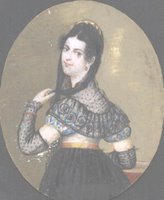
The first portrait is inscribed on the reverse "Mrs Atkins nee Miss Shutt married Thomas Atkins". A marriage of Thomas Atkins and Jane Shutt did take place in 1804, but the style of the dress of the sitter could suggest it may be from an earlier generation. 117


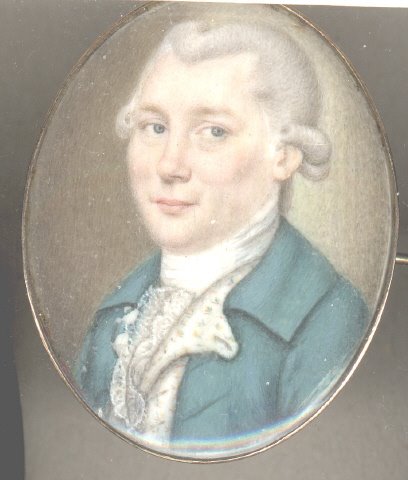
The second miniature portrait of a man wearing a green coat is accompanied by a note which reads; "Probably Thomas Atkins eldest son of the Thomas Atkins who married Ann Unwin. This one married Miss Shutt and had two children Thomas Shutt Atkins and Jane Atkins."

However at first thought, this seems a little doubtful, as the marriage of Thomas Atkins and Jane Shutt is recorded on 13 Sept 1804 at Walthamstow Essex, whereas the costume of this sitter looks to be closer to 1775.

Instead it seems perhaps more likely it is the Thomas Atkins who married Ann Unwin in 1773. 133

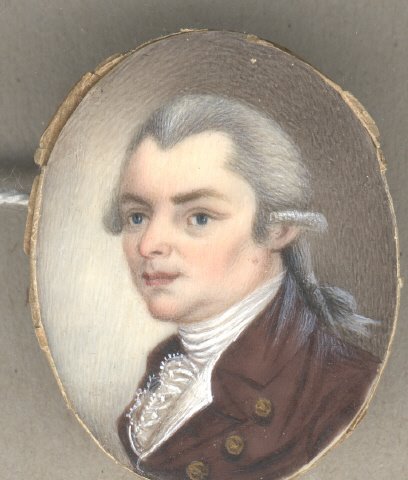
The third unsigned miniature portrait of a young man in a brown coat is accompanied by a note that reads "Thomas Atkins & Ann Unwin married at St Alphage, London Wall in 1773" and the marriage record for them has been located on 17 Jul 1773 at Saint Alphage, London Wall.

It may in fact be that the two notes have been reversed, with the man in the brown coat being the younger Thomas Atkins who was married in 1804, as the style of his coat collar and hair is somewhat later than that on the man in the green coat. 134

At The Proceedings of the Old Bailey, London 1674 to 1834 there is an interesting reference on 11 April 1833 to Thomas Shutt Atkins where he is a witness at the trial of a certain Thomas William Peppers on charges of deception and forgery. Thomas Shutt Atkins gives his occupation as insurance broker and appears to occupy premses at 20 Birchin Lane, London. The defendant, Thomas William Peppers was found guilty by the Court and was sentenced to be transported for life, presumably to Tasmania, Australia.


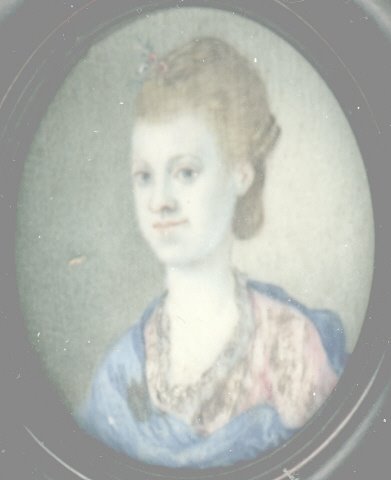
The fourth miniature portrait has the remains of a label on the reverse which reads as follows ""(sis)ter of Thomas Shutt Atkins - (a)unt of Thomas Howell Atkins". The sister of Thomas Shutt Atkins was a Jane Atkins, so she would seem to be this sitter.

However, Thomas Shutt Atkins' parents (Thomas Atkins and Jane Shutt) were only married in 1804 as per the adjacent notes. This lady seems to be wearing clothes from around 1780 and so it appears she is perhaps from an earlier generation of Atkins, perhaps even Ann Unwin, the mother of Thomas Atkins and thus the grandmother of Thomas Shutt Atkins. 135


The fifth portrait is believed to be Edward Warner who was married to his second wife. Ann in 1809, but died in 1815 aged 71 at Walthamstow.

Chilean collector - Antonio Meucci portraits

Shown here is a group of portraits associated with Antonio Meucci (Anthony Meucci) (?-1852). They have been kindly supplied by a descendant of Meucci, together with most of the information contained here. It therefore provides an opportunity to record some information about this artist who is not well known. The first one shown may well be a self portrait of the artist, or failing that a portrait of him by his wife Nina Meucci who was also a miniturist.

Meucci arrived in the United States from Rome, Italy in 1818 and worked in various American cities including New York, Portland (Maine), Richmond, Baltimore, Charleston, Salem MA, and New Orleans. His wife Nina was also a miniature painter and in 1824 they exhibited four miniatures at the American Academy of Fine Arts. While in Charleston they advertised that they could teach young ladies to paint figures, landscapes and miniatures in fifteen weeks. Meucci returned to New Orleans from Salem MA in 1826-7 and it seems that his last work in New Orleans was as a scenery and backdrop painter at the opera. Julien Hudson (Jules Hudson (?-1844) a black American was perhaps the first and only African miniaturist in USA before the Civil War and was a pupil of Meucci in New Orleans 1n 1826-7.

References have been found to a Anthony Meucci who lived in New York and was a stage painter. Antonio Meucci lived in that city and did this work in New York and elsewhere. As both also lived briefly in Cuba, it seems certain they were the same person.
The Meucci's left USA for good in 1827 heading for Havana Cuba. The next information known about Meucci is that he arrived in Cartagena, Colombia from Kingston, Jamaica about the middle of 1830 where he saw the very sick Simon Bolivar marching into town. While there Meucci painted a miniature portrait of Simon Bolivar, which is considered the last portrait of Bolivar painted from life. Meucci painted about 12 copies of this portrait. One of the portraits can be seen at www.museonacional.gov.co/body_propaganda.html For more about Simon Bolivar see Simón Bolívar - Wikipedia, the free encyclopedia Meucci painted widely in South America until 1837 and died before 1852 in Lima or Guayaquil.
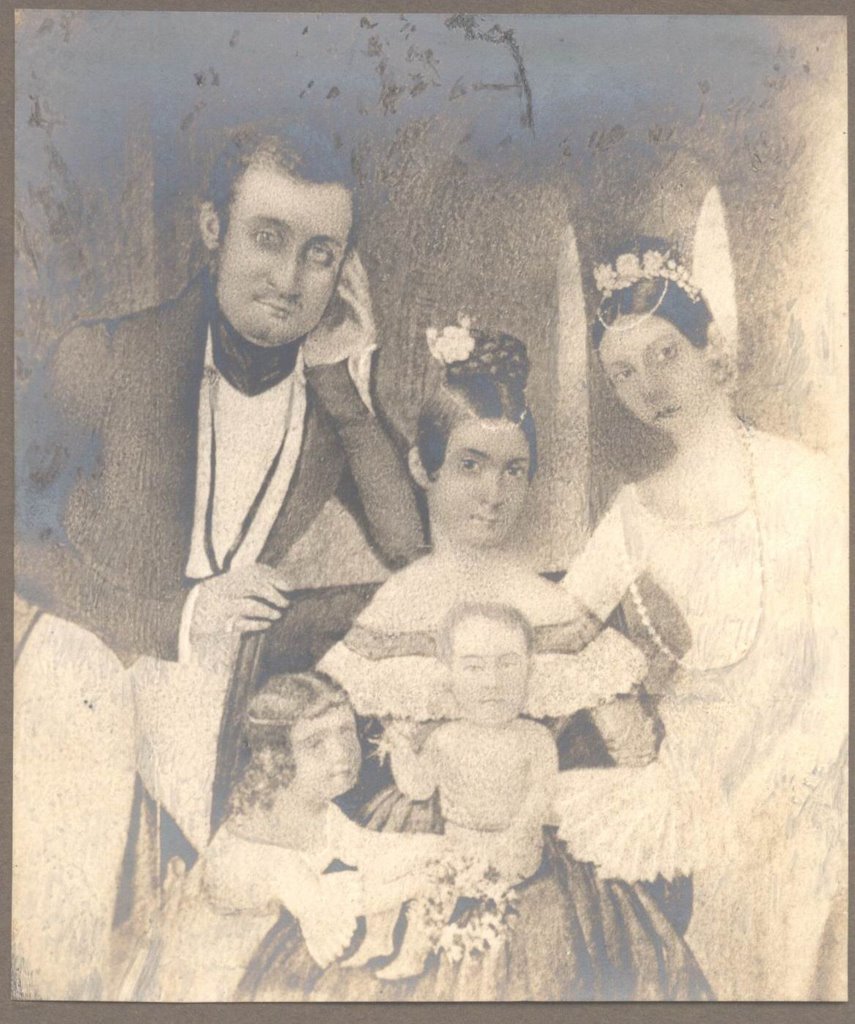
The portraits displayed include a family group (although this looks like a photograph, it is not a photograph, as can be seen from an enlarged version by clicking on it), which shows Richard Souter, formerly of Scotland, together with his wife Sabina Meucci (1805?-1884), who was the daughter of Antonio Meucci. Also in the group is Rosalba Huerta Meucci the daughter of Sabina by a previous marriage, so she must have been a widow. Richard Souter was either a diplomat or merchant in Colombia and may have drowned in a shipwreck in 1841 near Liverpool.The two small children in the group portrait are the owner's great grand aunt Helen Souter, who later married William Waddington in Chile and the baby is his great grand father Frederick Souter Meucci 1837 - 1876 who is buried in Valparaiso, Chile. The owner deduces that the portrait was drawn in Cartagena, Colombia in early 1838. However, it is not certain the portrait was drawn by Antonio Meucci, and may even be by Nina Meucci.

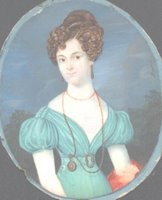
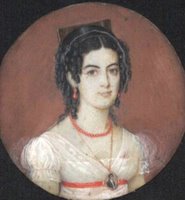
The three miniature portraits and one engraving of young ladies are all believed by the family to be portraits of Nina Meucci, made by Antonio. The lady in a white dress and wearing a miniature is wearing a shell comb that looks to be the same as the one in the engraving of Nina. The lady in green is signed Meucci on the left. The lady wearing the mantilla headdress is signed on the left "Nina Meucci by A Meucci 1822". The engraving of Antonio Meucci's wife shown here, is inscribed at the bottom "Signora Nina Meucci - Drawn on Stone from the Life by A Meucci". Nina was also a miniature painter.
On 27 February 1834 Meucci was advertising in a Lima, Peru newspaper offering to paint miniatures and natural sized portraits in oil. In the advertisement, he also offered to draw imitation engravings on ivory paper. Thus the portrait of his wife may be one of these, despite the statement that it is drawn on stone.

The owner of these portraits kindly allowed these portraits to be shared after seeing the portrait in this collection which is by Antonio, see Meucci, Antonio - portrait of a man and shown here as the man with a striped waistcoat.

There are also several portraits by Meucci in the New York Historical Society Collection, the Museum of New Orleans, and one in the Manney Collection.

Most of the following additional comments about his career have been also kindly supplied by the descendant of Meucci who owns these portraits.

The history of Meucci is typical of itinerant miniature painters. He entered the United States from Europe, arriving at cities where there were established artists. Additionally, it is probable that his command of English was initially limited. Thus he was not well placed to build up a clientele where miniatures could generally only be afforded by the well off or professional classes, who were a small minority of the community. Then, as now, paintings by established artists, were preferred, and once a couple had their own portraits painted, there was little opportunity for a painter to expect repeat business. Thus his gradual drift southwards, is a sign he was seeking new clients, as the following records show. The Spanish language is closer to Italian than English, which may have been an additional benefit that Meucci could exploit, whereas native English speaking artists from the USA tempted to move South to seek work, would have found the Spanish language a barrier.
MEUCCI IN COLOMBIA
1828 Meucci is believed to have made a trip to Bogota
1830 in Cartagena from Jamaica, when he painted Bolivar
1831 Rionegro
1832? Medellin
1832 Popayan in the South of Colombia, in his way to Peru

These trips can be followed by the trail of his paintings and comments made about him, as in the following quotation in "Papel Periodico Ilustrado" Year II page 411 by Alberto Urdaneta. "in those days decorative arts did not shine in these countries, which were devoted to the glories of Belona. We know nothing of the biography or aesthetic studies of the Italian Meucci, nor why or when he came to Colombia. If we can judge him by the works he left us, he was not an outstanding miniaturist, but an artist of spirit, because with love and eagerness he reproduced many times the image of "The Liberator".

The reason Meucci left Bogota, Colombia, is apparently because he had a quarrel and left Bogota hurt by the sarcastic, but perhaps correct criticisms of the acknowledged miniaturist Don Jose Maria Espinosa. The conflict between Meucci and Espinosa who were both painters of Bolivar, may have been because Meucci made copies of an original work by Espinosa. In fact many of Espinosas supposed originals are now considered to be the work of Meucci.
There are sometimes harsh criticisms of his work. In "los retratos de Bolivar" by Alfredo Boufton, there is the comment "A. Meucci was one of Bolivar's painters with the least realism. His drawing is often imperfect and his brush of a reduced and poor impression and colour blending".

Meucci was in Popayán in the South of Colombia in 1832 and he traveled from there to Lima Peru. It is likely that he made his trip by land to Quito-Ecuador and then to the port of Guayaquil, where he traveled by sea to the port of Callao and then to Lima where he lived several years. It was impossible to travel by land from Ecuador to Peru in those years. Meucci published in “The Mercurio Peruano” newspaper, on September 7, 1833 and then on October 18 and 19 the same advertisement, in a slightly archaic Spanish:

ANNOUNCEMENT TO THE PUBLIC. "Antonio de Meucci, portrait painter native from the city of Rome, has the honor to inform the most respectable public, that he has moved his studio to the corner of the small plaza of Saint Augustine, in the second floor of Mr. Blanco’s well known house, where the carpenter's shop is located. The many portraits that have been ordered, and the favorable reception that his works has attained in this city, makes him cherish the hope that he will be hired from now in the future, as he has been up till now in the practice of his art. A collection of his portraits are displayed in one of the parlors of the mentioned house and can be seen by the persons who would like to hire him. It is informed that ladies portraits will be perfectly finished in three days, taking the trouble of only half an hour each day, in whose homes he will attend at the agreed hour: and those of gentlemen will be completed in two days posing half an hour a day."

It is likely the collection of portraits, which he refers to in the advertisement, includes the miniatures of Nina Meucci shown above.

MEUCCI IN PERU

Meucci placed advertisements in several newspapers in Lima offering his services. In "El genio del Rimac" (newspaper) Lima 27 February 1834. "Don Antonio de Meucci Roman portrait painter offers his services to this respectable public in painting miniatures and also portraits of natural size. He also offers a new method of painting on ivory paper imitating engraving. Its cost will be only 12 pesos" etc etc.

Meucci was in Lima till 1834 and left for Guayaquil where he is thought to have lived for several years. In Guayaquil he trained the Peruvian painter Quispe (which is an Indian name). He was back in Peru in 1837 when he sold in Lima to the British Ambassador Dr. Bedford Wilson an unfinished portrait of Bolivar. Wilson added at the back with his own hand: "This is the best and only good interpretation of General Bolivar." Bedford Wison was a British (perhaps Irish?) officer on the staff of Simon Bolivar, where he was a trusted and close aide-de-camp. When Bolivia declared independence, Bolivar wrote its Constitution and commissioned Wilson and another English officer to carry the document to Bolivia in a trip of 1800 miles.

Another quotation about Meucci is found in an Internet Biography of Jose Maria Espinosa. "He was very prestigious in Lima by 1840 as the scenographer of an Italian Opera Company. His trail can be followed in Lima until about 1847". In 1843 Meucci's daughter Sabina Meucci, probably a widow, was in Lima as teacher of drawing and piano at the School of Santa Cruz de Atocha, a school for orphan girls. In 1845 Sabina was the principal of the "Colegio de Educacion del Espiritu Santo" (Educational College of the Holy Ghost) located in Miraflores, an elegant summer resort very near Lima.

It seems Meucci lived at least 15 years in Ecuador and Peru, much more than in Colombia or the United States, but has left no knowledge of any miniature or painting in this period. Meucci must have died between 1847 and 1851. It is presumed in Guayaquil, because Frederick Souter Meucci, the great-grand-father of the current owner attended school there. Sabina and her children migrated to Valparaiso Chile where her daughter Rosalba Huerta Meucci was living with her husband Manuel Belinfante.

The cost of his portraits has been deduced in the following manner. It appears that the price of the early newspaper The Mercurio Peruano's" was one Real and 8 Reales is believed to equal one Peso. So if .as mentioned above, Meucci charged 12 Pesos for one of his miniatures, that would make 12x8 = 96 Reales per portrait. As a newspaper now currently costs about $1 American dollar, Meucci would have earned about $100 dollars per portrait in present day values.

Meucci informed his clients that it would take one and a half hour for a lady to pose and a gentleman one hour in two sessions. This means that Meucci could easily paint 20 portraits a month if he had the clients, earning about $2,000, a month in present day values, which while not high, seems a reasonable estimate.

Santiago had a population of about 40,000 in Meucci" time and Lima could not have had more than 100,000 inhabitants. However, 90% of this population was poor and uncultured and had no interest in miniature painting. This means that Meucci had to work with a very small possible client population not more than 5000-10000 persons in the biggest cities. To make things worse for him, much of this limited population was babies and children, and other painters were working simultaneously.

Earlier thoughts had been that Meuuci was a kind of nomadic soul who worked in at least seven cities in USA in ten years, and painted in at least six cities in Colombia in two years, as well as other places in Central and South America. However, the reason for his wandering appears clear. If Meucci could paint easily 200 portraits a year, in a very few months he would run out of clients. Thus his wanderings were the results of a demographic problem, not the quality of his paintings, nor of his character. This probably also why he sought work as a scenery painter in many places.

The Other Antonio Meucci

As there is sometimes a little confusion with another Antonio Meucci who invented the telephone, the following are some details about him. This other Antonio Meucci (1808-1889) was an immigrant from Florence, Italy, who arrived in New York in 1835. It is a little difficult to track him through the census records, but his wife's name Esther is a clue. In the 1850 census he described himself as "Gentleman" and his place of birth is recorded as France, probably because the census taker misheard the word Florence. In 1860 he seems to be recorded as Antonio Mcio, a foreman in a candle works and he had a servant Mary Taney, presumably to look after his wife. His name is not obvious in later census records. When his wife, Esther, became paralysed in the 1850's he rigged a system to link her bedroom to his workshop. He held a public demonstration of his invention in New York in 1860, but was unable to aff0rd the $250 patent. In 1871 he filed a one-year renewable "notice" of an impending patent, but could not afford to renew it. Then in 1876, Alexander Graham Bell, who shared the laboratory with Antonio Meucci and thus had access to his work, successfully filed a patent for a telephone. Meucci sued, but the legal action ceased on Meucci's death in 1889. However, in June 2002, the United States Congress finally recognised Meucci as the father of communications.

Tuesday

American collector - portrait of Samuel Hoy Smith


These images of a miniature portrait have been kindly submitted for display by its current owner, Dave Ketterer who is keen to know more about the sitter.

Dave's grandmother was advised in around 1957 that it was by one of the Peales. Although I cannot confirm this, it does seem, based on a comparison of styles, that Raphaelle Peale (1774-1825) is the most likely member of the Peale family.

The sitter is Samuel Hoy Smith, a Mason and one of the original settlers of Knox Co. Ohio. Samuel Hoy Smith was born 24 Feb 1776 in New York and died 17 March 1862. His first wife was called Elizabeth. Later he married Jane Victor and they had nine children. There is a marriage recorded between Samuel Smith and Jane Victor on 16 Apr 1821 at Muskingum, Ohio.

Samuel Hoy Smith was the owner of a newspaper called "The Ohio Register", for more about it see KnoxCo., OH - Early Research Page There is also an Internet reference to Samuel Hoy Smith seeking a grant of land in 1825 on behalf of himself and several hundred other persons. Dave Ketterer has a lot of information about Samuel Hoy Smith and is particularly interested in tracing his first wife Elizabeth. Dave can be reached at ketterer@empireone.net

The portrait is painted on ivory and is believed to have been painted around 1801. The frame is a typical American one of that period, with woven hair under the reverse glass, and the sitter's costume supports a date of 1801. The engraving on the reverse "Mary Jane Smith 1860" is a later addition. At the bottom the word Leppleman is engraved, for Mary Jane Smith Leppleman, her married name as she married Edward H Leppleman on 29 Aug 1866.